


| Javascript |
|
|
|
|
|
We give here some basic facts of the theory of orthogonal
rational functions (ORFs). We assume that  denotes the
set of complex numbers,
 the open
unit disk,
 the unit circle, and
 the
exterior of the closed unit disk. Let
 be a probability measure on the unit circle.
 is the Hilbert space of all square
integrable functions with inner product

As a special case, one could choose to be the the normalized Lebesgue-Borel measure on
the unit circle, which will be denoted by  .
Let  . Then the Blaschke
factor
 is defined by

where  if
 . Let
 be a sequence in and let

Then the product

is called the n-th finite Blaschke product with respect
to the sequence , where  . (We assume everywhere that
 .) Define the fundamental space
 as

where  is the space of
polynomials of degree at most n and

Thus is the space of rational
functions with poles in  , where
 . In particular, when
 for all n, then
 . Note that the sequence
 is nested, i.e.,
 .
We define the para-hermitian conjugate  of a function f by

The superstar  for a function
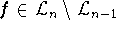 is defined as

Note that this transformation depends on the degree n.
Let  be the orthonormal
sequence obtained by orthogonalization of
 . Every such
 admits a representation

The coefficient  is the leading coefficient with respect to the basis
 . We shall denote it by
 . The are uniquely defined if we require that
 . Setting
 , we obtain ORFs with leading coefficient equal to
1. We call these
 the monic ORFs.
Elementary manipulations show that

and orthogonality implies that

with  and
 . Furthermore, the relations

are valid.
An explicit formula for the ORFs can be obtained as follows.
Let  be the Gram matrix

It is then not difficult to see that

and therefore

Like for the Szegö polynomials, it holds that has all its zeros in the open unit disk.
There is also a Christoffel-Darboux type of relation given by

The left hend side is the reproducing kernel for .
There are generalizations of the Szegö recurrence relations, given by

and

The recursion coefficients  and
 are given by
and
The practical computation of the ORFs that has been used here
is based on a Nevanlinna-Pick interpolation algorithm which
generates the recurrence coefficients  and
 , which are then used in the recurrence relation.
For some history, we refer to Section 4.
For a selected bibliography, we refer to the list of references at the last page.
|
|
|
|
|

