 we consider parabolic problems of the form
Meeting of The Scientific Research Network
Advanced Numerical Methods for Mathematical Modelling
29 November 1996, 2.00 -- 6.00 pm, Aula Qc, VUB.
Abstracts
Pieter de Groen, Vrije Universiteit Brussel
In this talk we give a short and elementary introduction to singular perturbation problems.
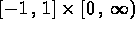
On the semi-infinite strip
we consider parabolic problems of the form

and the associated two-point boundary value problem for the steady state

In these equations  is a small positive parameter.
Guided by some examples, we show how we can construct asymptotic
approximations and how these may depend sensitively on initial and bounday data.
G.E. Karadzhov, Institute of Mathematics and Informatics, Bulgarian Academy of Science
Consider the following family of operators in 


where the function a is smooth, real valued,  and
h is a cutoff function. This family arises in the solvability theory for
a corresponding linear partial differential operator with double characteristics.
The problem is to investigate the small eigenvalues as
 At least two approaches are possible. The first is to find the
asymptotics of the eigenvalues as
 and to study the
properties of the coefficients as functions on
 The second is to isolate the small eigenvalues applying a localization
procedure to the eigenfunctions. In particular, if
 then we
have only one small eigenvalue which is a smooth function on

D. Hilhorst, Université de Paris Sud, Orsay
In this talk, we present joint work of A. Bonami, D. Hilhorst, E. Logak and M. Mimura on the evolution problem
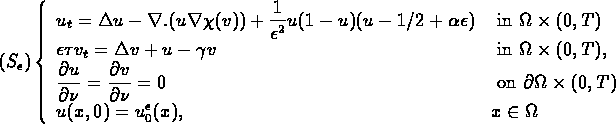
which has been proposed by Mimura and Tsujikawa to describe
chemotaxis with growth.
Chemotaxis is a phenomenon observed in biology, in which biological individuals migrate towards higher gradients of some chemical substance - the chemotactic substance - which is produced by themselves. In the above system, the functions u and v are respectively the density of biological individuals and the concentration of chemotactic substance.
Let  be the solution of system
 .
As
 tends to 0, the function
 tends to the characteristic
function of a moving domain
 , whose boundary
 is the
solution of the free boundary problem
 ,
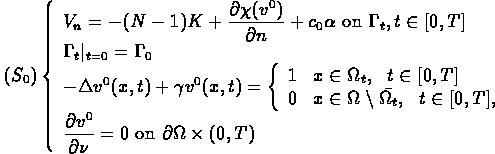
where n is the outward unit normal vector on  ,
 is the
normal velocity on
 and K is the algebraic mean curvature on
 . The term
 is the velocity of the one-dimensional
travelling front solution of a corresponding scalar bistable
equation.
We prove the existence and uniqueness of a smooth solution of Problem
 locally in time.
We then establish the convergence of the solution of Problem
 to
the solution of Problem
 in the case that
 in the second
equation.
Finally we show that properties such as the inclusion and the convexity of
interfaces are not conserved in time.
Arjen Doelman, University of Utrecht
joint work with Tasso Kaper (Boston), Paul Zegeling (Utrecht)
In this presentation we will discuss the pattern
generating dynamics of the one-dimensional reaction-
diffusion model developed by Gray and Scott to describe
the autocatalytic reaction 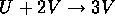 . This model
exhibits so-called "self-replicating spots", i.e. a
"spot" of high V-concetration splits in two. The "new"
spots travel away from each other and split again (etc.).
The main tools in our study of this behaviour are (i)
geometric singular perturbation theory for the mathematical
analysis and (ii) a recently developed moving grid code
for the numerical simulations. The combination of these
two ingredients enables us to understand some crucial aspects
of the behaviour of the solutions of the Gray-Scott model.