CREA research project

CREA-13-012 CUASSA: Can Unconventional Eigenvalue Algorithms Supersede the State of the Art (1-1-2013 to 31-12-2014)
Description
SIAM News published in 2000 The best of the 20th Century: Editors Name Top 10 Algorithms. This list includes the QR-algorithm for computing eigenvalues. We quote: Eigenvalues are arguably the most important numbers associated with matrices - and they can be the trickiest to compute In this proposal the QR-algorithm will be revisited. We do not aim at minor improvements of existing theories or algorithms, but at a fundamental research restart situated at the mathematical foundations underlying this algorithm.
The greater objective of this proposal is to deliver a new theoretically well-founded eigenvalue solver superseding one of the top 10 algorithms of the 20th century: the QR-algorithm.
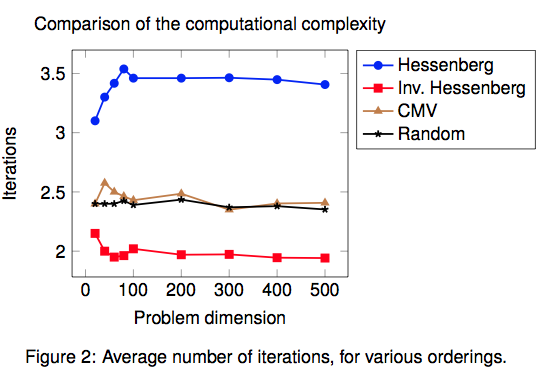
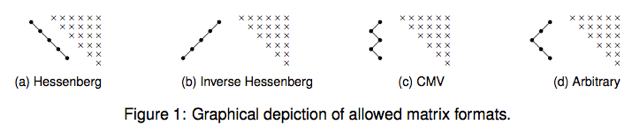
The whole QR-algorithm is centered around a particular factorization of a particular matrix: the QR- factorization of the Hessenberg matrix, both, intimately linked to each other. A first step towards a big innovation was the focus shift towards the factorization, instead of pursuing investigating the long-established Hessenberg matrix. The big metamorphosis was, however, the identification of the essential features of the factorization enabling the design of the QR-eigenvalue solver. This identification revealed the existence of, a formerly unknown, flexibility, allowing the generalization to a whole class of new, unconventional QR- algorithms. Instead of a sole matrix, the Hessenberg matrix, we now have 2n1 (with n the matrix dimension) options amongst which we desire now to pick the most suited shape.
Recently the first research steps beyond the Hessenberg matrix, retaining all essential features, have been undertaking by the research team. The efforts in this direction are increasing rapidly and successfully, yet many questions remain unanswered. We are standing at the beginning of an unknown area of new opportunities. The existence of novel unconventional algorithms might lead to a fundamental twist in the world of eigenvalue computations, and might have a groundbreaking, far-reaching impact in the world of scientific computing. Undeniably “might lead” is in place, since this is unexplored territory and the outcome of these investigations is so far undetermined. The potential impact can be high and we are convinced that all theoretical and algorithmical contributions will be exceptionally valuable.