Masterproef T704 : How to perform Gibbs sampling for big data analytics?
|
Begeleiding:
|
||||||
|
Onderzoeksgroep:
Numerieke Approximatie en Lineaire Algebra Groep
Technische Wetenschappelijk Rekenen |
||||||
|
Context:
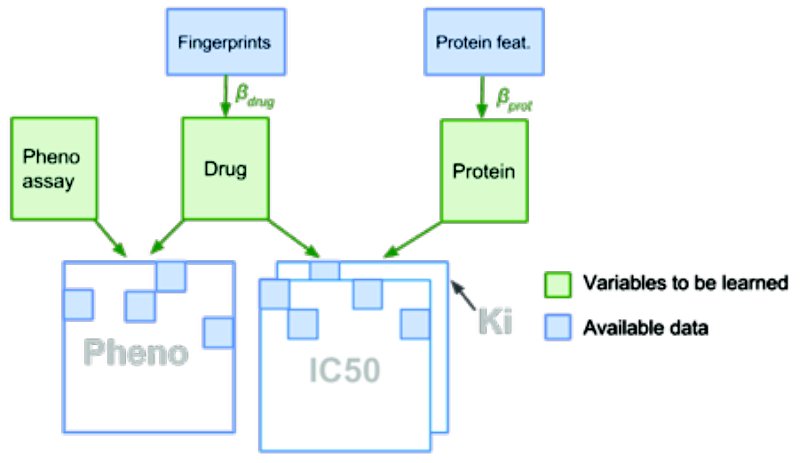
The low rank factorisation of an incompletely filled matrix into latent vectors in a Bayesian setting can be done by so-called Gibbs sampling. A sequence of samples is built, where each of them is the result of the solution of a large scale regularized linear system. The thesis is carried out in the framework of a project with Janssen farmaceutica.
Doel:
We will develop a conjugate gradient iterative solved for this system using properties of the underlying data matrices. |
||||||
|
Uitwerking:
The student starts reading papers to become familiar with the concept of Gibbs sampling. The main work lies in the solver of the linear system, which can be very large. The system matrix cannot be computed explicitly (it is known as the product of two large sparse matrices). Several toptics will be addressed:
|
||||||
|
Profiel:
The work involves some theory and some practical implementations to test the different ideas. Knowledge of machine learning is not required but may be helpful for understanding the context. Matlab or python can be used initially for small tests, but in the end, it is possible that, for realistic data sets, a compilable language should be used. Deze masterproef is voor 1 or 2 studenten. |