Masterproef T713 : Tensor-based graph clustering
|
Begeleiding:
|
||||||
|
Onderzoeksgroep:
Numerieke Approximatie en Lineaire Algebra Groep
|
||||||
|
Context:
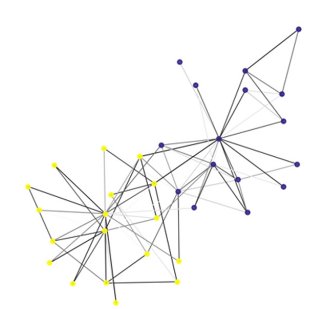
Networks and graphs are ubiquitous: from physical systems such as energy and transport networks, biological networks of metabolic pathways and gene regulation, to online social and information networks. On the other hand, an important research trend is the transition from vector and matrix based mathematical engineering to generalizations that make use of higher-order tensors. Higher-order tensors are “matrices in more than two dimensions". This trend manifests itself across many disciplines, such as signal processing, data mining, machine learning, scientific computing, ...
Doel:
Graph analysis usually starts from the adjacency matrix. An entry of the adjacency matrix is non-zero when the two corresponding vertices are connected. On the other hand, it is also possible to derive a higher-order tensor from a graph. We can for instance make an entry non-zero for all triangles that are connected. There are in fact many ways to derive higher-order tensors from a graph. In the construction we may take into account specificities of the graph that we wish to exploit (densely connected subgraphs, cyclic structures, graph layers, ...). The tensor setting also provides conceptual alternatives for matrix-based spectral clustering. The use of tensor decompositions as an alternative for matrix eigenvalue decomposition is almost unexplored. An important aspect is that matrices and tensors derived from a graph are most often very large but also very sparse. This sparsity needs to be taken advantage of in the computations. The goal of the thesis is the exploration of novel conceptual possibilities, the derivation of tensor-based algorithms for graph clustering and the implementation of these algorithms in Matlab. |
||||||
|
Uitwerking:
The required know-how w.r.t. tensor methods is acquired through discussions, attending a few lectures and a limited, guided study of the literature. A concise course text is available. Then algebraic possibilities are explored and new algorithms are developed with attention for computational aspects. The algorithms are validated on practical examples. |
||||||
|
Profiel:
Depending on the interest, the emphasis can be put less or more on the theoretical foundations, numerical aspects or software implementation. The algorithms are implemented in Matlab. Deze masterproef is voor 1 or 2 studenten. |